Eternal Optimist's second daughter, Z, has been visiting with us the last week or two here in Big Coldtown (BCT). She's married, and lives far away in a foreign and enchanted place. She enjoys being back in the land of green vegetation and sarcasm.
Last Thursday she decided to go visit a friend in the City. She started out "late" - by Eternal Optimist's standards - around 11 p.m. This is not "late" by Z's standards. Eternal Optimist is in bed by 10, most nights. Mrs. Optimist, ever vigilant, sprinkled Holy Water on Z before she left. She kissed her goodbye.
Around 1:30 a.m. a knock at our bedroom door roused EO from his slumber. EO does not rouse well, but does rouse often during the night. He does not have the gift of sound sleep. He used to, but then he had a large family. Whole different story, for another blog. His experience has been that nothing much good happens after midnight, whether phone calls or knocks on the door.
"Yes" said EO, as diplomatically as possible, through his CPAP machine. "It's Z, dad" came the answer. "Yes" said EO, as kindly as possible, which probably did not sound terribly kindly, but perhaps came across as patient, EO hopes.
"My friend didn't have any place to stay tonight and I told her she could stay here" said Z. Z has a very sharp tongue and a very big heart. She picks up strays along the way. I figured we'd make the girl coffee in the morning and listen kindly to the story. Maybe make her an omelet, too. Always good to feed people after they've had some harsh domestic issue.
"That's fine" said EO and Mrs. EO, who was also half awake.
"I'm going to put her in my room" said Z.
"Okay" said EO, glad that Z was alive and had not had an accident, and already falling back asleep.
"She would like to say hi and thank you" said Z.
"That's okay" said Mrs. EO and EO in unison. "We'll see you in the morning." My eyes were already shutting. The tone of my voice had probably deteriorated a little by now.
"She really wants to say thank you, dad" said Z.
Pause. "Okay" I said, mustering all the patience I could. Which was not much, compared to Mrs. EO, or perhaps most other human beings. The stray leaned in our bedroom as I tried to sit up in bed a little bit and take my Darth Vader CPAP mask off. It's very off-putting. As the lights were not on, and I had no intention of putting them on, I wasn't too worried about my ratty T-shirt, unshaven face and matted hair.
"Hi" said a 20 something voice. "My name is Rae . . ."
At the mention of her name Mrs. EO sat bolt upright and said "Whaaaaaaa.........?????????????"
It was my oldest daughter, Rae, who had made a snap decision with her sister to fly out and visit us for the weekend!
What a wonderful surprise!! The two of them just couldn't bear not to make it an elaborate scam, to boot. They managed to pull the whole thing off without lying, either. We talked until 3:30 in the morning. I was my usual delightful self at work Friday, except that I mumbled a lot and drank a lot of coffee. Come to think of it, I do that normally, so probably no one noticed anything different.
I am so impressed with my kids. And I love them so much!
Saturday, August 11, 2012

Thursday, August 2, 2012
HOPE, CHANGE & IMPENETRABILITY

Mr. Obama's July 13, 2012 speech in Roanoke, Virginia (a lovely town) contained a line that has become quite infamous, in just a matter of weeks:
"If
you’ve got a business -- you didn’t build that. Somebody else made that
happen."


Mr. Obama's defenders insist that the line has been "taken out of context." This phrase, "taken out of context," is a kind of warning bell when Mr. Obama uses his superpowers to change the meaning of words.
In similar fashion, when Mr. Obama said that Obamacare was NOT a tax, while it was being voted upon, many took this out of context. What he meant to say was that it WAS a tax, as his lawyers clarified during arguments before the Supreme Court.

Here are 3 paragraphs of context from the President's speech: the paragraph in which the offending sentence occurred, as well as the paragraphs before and after:
There are a lot of wealthy, successful Americans who agree with me -- because they want to give something back. They know they didn’t -- look, if you’ve been successful, you didn’t get there on your own. You didn’t get there on your own. I’m always struck by people who think, well, it must be because I was just so smart. There are a lot of smart people out there. It must be because I worked harder than everybody else. Let me tell you something -- there are a whole bunch of hardworking people out there. (Applause.)
If you were successful, somebody along the line gave you some help. There was a great teacher somewhere in your life. Somebody helped to create this unbelievable American system that we have that allowed you to thrive. Somebody invested in roads and bridges. If you’ve got a business -- you didn’t build that. Somebody else made that happen. The Internet didn’t get invented on its own. Government research created the Internet so that all the companies could make money off the Internet.
The point is, is that when we succeed, we succeed because of our individual initiative, but also because we do things together. There are some things, just like fighting fires, we don’t do on our own. I mean, imagine if everybody had their own fire service. That would be a hard way to organize fighting fires.
In the larger context, Mr. Obama's speech advocated big tax increases for businesses because they benefit from all the great things government does, like roads and bridges. It is only "fair" that businesses should give us even more of their wealth than they already do, through paying most of our taxes. His offending sentence makes sense, again, in the larger context.
If what he meant to say was that "if you own a business - - you didn't build [roads and bridges that your business uses]," what was the point? He just got done saying somebody [else] invested in roads and bridges. He needed to say that twice? Was someone having trouble with that concept? BTW, the "someone" who built the roads included the business owners, just like everyone else, who paid their taxes. so the whole idea makes no sense. Twice.
Mr. Obama is Harvard educated, as we've been told many time by his admirers in the press. If he did not mean what he said, then things get much more worrisome, because
- he is saying gibberish without being aware of it
- he has catastrophic difficulties using pronouns properly
- he was speaking in a super-secret language that only he and his followers can understand
Mr. Obama's speech sounds like some kid smoking pot while trying to write his sociology paper:
'Cause like, dude, we all helped with that business, you know? Like, its like a fire, you know? It's like a fire, man. A FIRE. We all helped put out the fire. Which helped your business, dude, cause it didn't, like, burn. Remember that?I don't remember any government helpers when I owned and ran a business. All the risks were mine, all the taxes were the government's. I'd had some good grade school teachers, as Mr. Obama mentioned. I'd driven on the interstate system a number of times, but then, I'd also paid a lot of taxes and tolls, and so had my parents. So I figured we were even. No one mentioned I would have to pay vigorish on all that later.
Luckily I did not loose my shirt before I found out I wasn't very good at business. It gave me a healthy respect for good businessmen and women, though. Mr. Obama thinks they are just lucky freeloaders.
He is grossly mistaken, but that is not surprising, given his limited resume. He has been a community activist, a politician, and a writer of self-laudatory fictions. It is not shocking that he thinks businesses are parasites living off the hard work of the rest of us. Nevertheless, he is quite misguided.

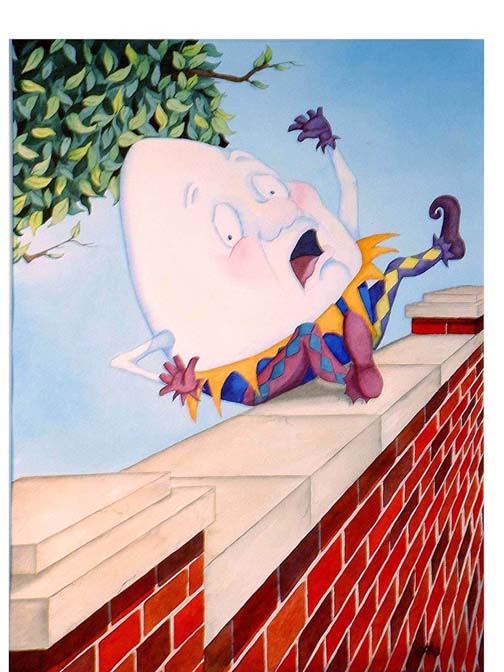
Mr. Obama's speech veered between opacity and nonsense. We've all bordered on incoherence, but Mr. Obama has help from speechwriters and teleprompters. He should hire new speechwriters and get the teleprompters serviced. His explanation of what he really meant to say reminds me of Humpty Dumpty, in "Through the Looking Glass:"
"When I use a word," Humpty Dumpty said, in rather a scornful tone, "it means just what I choose it to mean—neither more nor less."
"The question is," said Alice, "whether you can make words mean so many different things."
"The question is," said Humpty Dumpty, "which is to be masterthat's all."
Alice was too much puzzled to say anything, so after a minute Humpty Dumpty began again.
"They've a temper, some of them—particularly verbs, they're the proudest—adjectives you can do anything with, but not verbs—however, I can manage the whole lot! Impenetrability! That's what I say!"Hope, Change, and Impenetrability: Obama, 2012.
Wednesday, August 1, 2012
FIRST AMENDMENT CHICKEN

For those that don't know it, August 1, 2012 was "Chick-fil-A Appreciation Day." If you missed it, be sure to go and get some chicken and support these nice folks, who generally stick to cooking. Recently they've been criticized by the mayors of Chicago and Boston because of remarks by Chick-fil-A's president, stating that he believes marriage is the union of a man and a woman.
Apparently this is un-American, and the mayors of Beantown and Chicagoland had to let Chick-fil-A know that they wouldn't be getting approvals to do business in Boston or Chicago, not with that attitude.
You have to admire the moral courage of these two mayors, bravely standing up to a fried chicken store owner.
Rahm Emanuel, mayor of Chicago, said “Chick-fil-A’s values are not Chicago values. They’re not respectful of our residents, our neighbors and our family members. And if you’re gonna be part of the Chicago community, you should reflect Chicago values.” Emanuel is also co-chair of President Barack Obama’s reelection campaign, and President Obama's former chief-of-staff.
Here's a reaction to Emanuel's remarks from Cardinal Francis George, of Chicago, drawn from the Catholic World News:
Recent comments by those who administer our city seem to assume that the city government can decide for everyone what are the “values” that must be held by citizens of Chicago. I was born and raised here, and my understanding of being a Chicagoan never included submitting my value system to the government for approval. Must those whose personal values do not conform to those of the government of the day move from the city? Is the City Council going to set up a “Council Committee on Un-Chicagoan Activities” and call those of us who are suspect to appear before it? I would have argued a few days ago that I believe such a move is, if I can borrow a phrase, “un-Chicagoan.”
“The value in question is espousal of ‘gender-free marriage,’” he continued. “Approval of state-sponsored homosexual unions has very quickly become a litmus test for bigotry; and espousing the understanding of marriage that has prevailed among all peoples throughout human history is now, supposedly, outside the American consensus.”
“Was Jesus a bigot?” Cardinal George added. “Could Jesus be accepted as a Chicagoan? Would Jesus be more ‘enlightened’ if he had the privilege of living in our society? One is welcome to believe that, of course; but it should not become the official state religion, at least not in a land that still fancies itself free. Surely there must be a way to properly respect people who are gay or lesbian without using civil law to undermine the nature of marriage.”"Was Jesus a bigot" is a phrase that rather lingers in the mind. What Rahm Emanuel and others are saying is that to the extent Christian teachings conflict with the views of the government they must be - and deserve to be - suppressed. This is the premise of the HHS mandates.
So eat some chicken in support of our religious freedoms. And avoid Chicago, which is on pace to have 500 murders this year.
Chicago values, indeed.
Monday, July 30, 2012
MEDITATION ON THE HUMAN CONDITION
Eternal Optimist writes his children periodic emails, short meditations on the daily scriptures read in the Catholic Church. This one was from July 28, 2012, Saturday. It turned into a meditation on the human condition.
But here's the tough part. It is easy to see the hypocrisy in others. Seeing our own blind spots is much more difficult. Our eyes look outward, not inward. How do we invert our eyes so that we can see our own souls as Christ sees them?
All humanity is subject to the truth of the parable in today's gospel. Jesus tells of the farmer who sows good seed in the field, goes to sleep, and wakes up to find that an enemy has sown weeds among the good seed. The servants ask the farmer if they should pull up the weeds, but he tells them not to, because they may destroy the wheat in so doing. He promises that at the harvest he will have the harvesters separate the weeds and burn them, and then gather in the wheat.
Blessed they who dwell in your house!
continually they praise you.
Blessed the men whose strength you are!
They go from strength to strength.
I had rather one day in your courts
than a thousand elsewhere;
I had rather lie at the threshold of the house of my God
than dwell in the tents of the wicked.
Our time in the Lord's dwelling place is time when our hearts grow
toward the light of his love. We are "blessed" there. We go from
"strength to strength" - His strength becomes our strength. And however
you are situated in God's house - whether you merely lie at the
threshold, like the beggar Lazarus in one of Jesus' stories - you will
receive life. And however briefly you are in the Lord's house, you will
receive life: "I had rather one day in your courts than a thousand
elsewhere."
It is so difficult to see inwardly. God our Father loves us with all his heart, in all his truth and justice. In truth, none of us is satisfied with love that is blind to our weaknesses. That is a perilous love, sure to be shattered when it awakens from its dullness and sees us for what we are.
Neither do any of us truly want a "love" that justifies our injustice, that coddles our selfishness. Because we know in our deepest beings that this is not love. A "love" that tolerates selfishness and injustice is no love at all, but a temporary alliance, like a "den of thieves." It exists so long as our selfishness and injustice are directed elsewhere. We know in our hearts that in the end our selfishness and injustice will turn on our den-mates, and theirs on us. And that is the day they will not be our "friends" any longer.
The Lord gives us a place we can go and see ourselves for what we are, without dying of shame. It is a place where we are loved unconditionally, but not blindly, given true hope, not false pride, and given strength to change, not rationalizations for our sins. It is the place where the weeds get disentangled from the wheat.
That is why the Lord lived and died for us. That is why he instituted the Eucharist, appointed the Apostles, gave us Confession, and gave us the Holy Scriptures. He gives us the means to change, to gently pull out the weeds and to nurture the wheat in our lives.
I tell you to go to Church because I love you.
Today's readings are drawn from Jeremiah 7, Psalm 84, and Matthew 13. You may read them here.
Jeremiah
receives a message from the Lord, directing him to stand at the gate of
the temple and tell the people "Reform your ways and your deeds. . .
Only if you thoroughly reform your ways and your deeds; if each of you
deals justly with his neighbor . . . will I remain with you in this
place."
Jeremiah warns the people against
putting their trust in "the temple of the Lord! the temple of the Lord!
the temple of the Lord!"
This is a warning to
us, as well. Religious practice is a good thing, but not enough. The
Lord wants our lives. He wants us to deal with our neighbors
justly. Our "religion" is worthless unless it changes us for the
good. It is of no use unless it results in love toward our families,
friends and neighbors. It is quite disgusting to be a "religious"
person who mocks God by mistreating the people around him. Jeremiah
asks if we think God's temple is a "den of thieves?" Do we think God
does not see us for who we are?
But here's the tough part. It is easy to see the hypocrisy in others. Seeing our own blind spots is much more difficult. Our eyes look outward, not inward. How do we invert our eyes so that we can see our own souls as Christ sees them?
All humanity is subject to the truth of the parable in today's gospel. Jesus tells of the farmer who sows good seed in the field, goes to sleep, and wakes up to find that an enemy has sown weeds among the good seed. The servants ask the farmer if they should pull up the weeds, but he tells them not to, because they may destroy the wheat in so doing. He promises that at the harvest he will have the harvesters separate the weeds and burn them, and then gather in the wheat.
The truth of this parable applies in each
individual heart, as well. There weeds grow along with the wheat. The
roots of the weeds circle around our hearts, and are intermingled with
the roots of the wheat, so that God refuses to act in his power to "pull
up the weeds," lest he crush the life out of us.
Yet
in the person of Jesus the Lord asks us to let him disentangle the
weeds and the wheat gently, so that he can claim our hearts.
How do we do this?
Today's Psalm provides an answer:
How lovely is your dwelling place, Lord, mighty God!
My soul yearns and pines
for the courts of the LORD.
My heart and my flesh
cry out for the living God.
for the courts of the LORD.
My heart and my flesh
cry out for the living God.
Blessed they who dwell in your house!
continually they praise you.
Blessed the men whose strength you are!
They go from strength to strength.
I had rather one day in your courts
than a thousand elsewhere;
I had rather lie at the threshold of the house of my God
than dwell in the tents of the wicked.
It is so difficult to see inwardly. God our Father loves us with all his heart, in all his truth and justice. In truth, none of us is satisfied with love that is blind to our weaknesses. That is a perilous love, sure to be shattered when it awakens from its dullness and sees us for what we are.
Neither do any of us truly want a "love" that justifies our injustice, that coddles our selfishness. Because we know in our deepest beings that this is not love. A "love" that tolerates selfishness and injustice is no love at all, but a temporary alliance, like a "den of thieves." It exists so long as our selfishness and injustice are directed elsewhere. We know in our hearts that in the end our selfishness and injustice will turn on our den-mates, and theirs on us. And that is the day they will not be our "friends" any longer.
The Lord gives us a place we can go and see ourselves for what we are, without dying of shame. It is a place where we are loved unconditionally, but not blindly, given true hope, not false pride, and given strength to change, not rationalizations for our sins. It is the place where the weeds get disentangled from the wheat.
That is why the Lord lived and died for us. That is why he instituted the Eucharist, appointed the Apostles, gave us Confession, and gave us the Holy Scriptures. He gives us the means to change, to gently pull out the weeds and to nurture the wheat in our lives.
I tell you to go to Church because I love you.
Saturday, July 28, 2012
HEALTH CARE INJUNCTION
A district court in Colorado issued a preliminary injunction yesterday forbidding the federal government from enforcing its abortion and birth control insurance mandates against a private employer. You can read the opinion itself here, and the briefs of the parties here.
The issues in the religious exemption cases are entirely different from the recent Supreme Court decision on the Commerce Clause and Tax justifications for the law. The religious exemption cases do not attack Congress' power to pass the law, generally. These cases attack the application of the law to people who have religious beliefs that would be violated by complying with the law.
The judge ruled that the freedom of religion “questions going to the merits . . .[are] so serious, substantial, difficult, and doubtful as to make the issue ripe for litigation and deserving of more deliberate investigation[.]” The judge held that, given the alternative means for providing birth control and abortion coverage for women (such as free government abortion and birth control benefits), the government failed to meet its burden of demonstrating that its mandate was the least restrictive means of furthering its purposes.
The judge also held that given the numerous exemptions and grandfathered provisions in the health care mandate, the government had not proven that it had a compelling interest in uniform application of the mandate. In plain words, the judge said that given the number of exemptions already in place, allowing one more employer to avoid providing birth control or abortion coverage was not going to result in a system crash.
The opinion deals with one employer in one federal district. Nevertheless, the opinion has momentous implications, because the logic of the opinion applies to other people who want to run their businesses without violating their church's teachings on abortion and birth control. The opinion is a lucid explanation of why the preliminary injunction should issue. Because it was written by a Carter appointee, political hatchet men will have a tougher time slandering the judge as a conservative bigot.
Once again, a court holds that Nancy Pelosi's "are you kidding?" mockery of the notion that Obamacare might be unconstitutional was misguided. As the court said, the issues are "serious, substantial, difficult and doubtful."
We live in interesting times.
The issues in the religious exemption cases are entirely different from the recent Supreme Court decision on the Commerce Clause and Tax justifications for the law. The religious exemption cases do not attack Congress' power to pass the law, generally. These cases attack the application of the law to people who have religious beliefs that would be violated by complying with the law.
The judge ruled that the freedom of religion “questions going to the merits . . .[are] so serious, substantial, difficult, and doubtful as to make the issue ripe for litigation and deserving of more deliberate investigation[.]” The judge held that, given the alternative means for providing birth control and abortion coverage for women (such as free government abortion and birth control benefits), the government failed to meet its burden of demonstrating that its mandate was the least restrictive means of furthering its purposes.
The judge also held that given the numerous exemptions and grandfathered provisions in the health care mandate, the government had not proven that it had a compelling interest in uniform application of the mandate. In plain words, the judge said that given the number of exemptions already in place, allowing one more employer to avoid providing birth control or abortion coverage was not going to result in a system crash.
The opinion deals with one employer in one federal district. Nevertheless, the opinion has momentous implications, because the logic of the opinion applies to other people who want to run their businesses without violating their church's teachings on abortion and birth control. The opinion is a lucid explanation of why the preliminary injunction should issue. Because it was written by a Carter appointee, political hatchet men will have a tougher time slandering the judge as a conservative bigot.
Once again, a court holds that Nancy Pelosi's "are you kidding?" mockery of the notion that Obamacare might be unconstitutional was misguided. As the court said, the issues are "serious, substantial, difficult and doubtful."
We live in interesting times.
Sunday, July 8, 2012
STOP JEERING FOR A MINUTE
The flap about the HHS mandate has not only made clear the Administration's antipathy toward orthodox Christianity, but has also brought to the fore a long-simmering problem within the Catholic Church: birth control.
The Church teaches that artificial - as opposed to natural - methods of contraception are morally wrong. The majority of American Catholics do not adhere to the Church's teaching, although a substantial minority of American Catholics follow the Church's teachings.
As a convert to Catholicism, I continue to be mystified at the efforts of people born into the Catholic Church to redefine Catholicism in their own image. As centuries of Protestantism have demonstrated, if you don't believe what the Catholic Church teaches, you may either find a denomination that agrees with you, or invent one of your own.
Better yet, why not actually study what the Church teaches? A recent study in Big Cold Town, where I live, revealed that more than 50% of those who call themselves Catholic think that Jesus sinned. Since the Church has been clear about this particular issue for 2000 years or so, it is hard to understand how Catholics get this so wrong. It appears many Catholics do not have the foggiest notion about what the Catholic Church believes.
If you want to study what the Church believes about human sexuality, Pope John Paul II wrote a terrific book called "Theology of the Body." The book considers the philosophical and theological underpinnings of the Church's teaching on human sexuality. If you want "Theology of the Body for Beginners," a very readable and concise overview of the Pope's book, it is $7 online. Check it out.
One reason Catholics don't actually know what the Church teaches is that many priests don't actually teach them. Here's an article on a priest who actually preaches about what the Church teaches.
No one argues that artificial birth control must be a categorical moral good, without which the whole idea of morality crumbles. The arguments in favor of artificial birth control are varied, but basically boil down to two:
As for the second, it both assumes that population control is a good thing, and that there are no countervailing moral considerations. Yet murder and forced sterilization might be thrifty ways to control the population - and have been advocated by population control enthusiasts - but we don't approve of either one. So the idea is at least out there that there might be some moral limits on what we do to keep from having more people around. We cannot use every means available to control the population.
And as for the assumption that "population control" is a good thing, maybe not so much. It hasn't worked out the way everyone seemed to think it would, as demographic studies over the last 10 years have begun to demonstrate.
The Church's teaching is founded on a perfectly rational view of the value of human life and our duty to preserve and honor it.
The Church views human life as a profound good, worthy of protection and honor at every stage of development, no matter how weak, and no matter how wounded. This view informs the Church's views on caring for the sick, the poor, the elderly, and even criminals, and is responsible for much that is good in this feckless and uncaring world.
It is very difficult to argue against the Church's view of the dignity of human life. This should at least give pause to people who want to dismiss the Church's position on artificial birth control as illogical or unreasonable.
The Church's teaching is also founded on a perfectly rational scientific view of when life begins, a view that is adopted by every standard text on embryology and human development: human life begins at conception. Coherent arguments that human life does not begin at conception are difficult to make and more difficult to defend. This should at least give pause to people who want to abuse the Church's position without engaging in a serious discussion about it.
This is all to say that perhaps we could turn down the volume on the shouting, and stop jeering at the Church long enough to actually think seriously about what it is saying. Is the Church's position so obviously ludicrous that it deserves to be laughed at? Are sterility and promiscuity so obviously universal moral goods that we should never be permitted to breathe a word of criticism about either one, on pain of being tarred and feathered in the public forum?
Perhaps we could stop the carousel for just a few minutes and think about this. We might conclude, after some serious reflection, that the Church is right, and - heavens! - its critics are wrong.
I'm just saying. It could happen.
The Church teaches that artificial - as opposed to natural - methods of contraception are morally wrong. The majority of American Catholics do not adhere to the Church's teaching, although a substantial minority of American Catholics follow the Church's teachings.
As a convert to Catholicism, I continue to be mystified at the efforts of people born into the Catholic Church to redefine Catholicism in their own image. As centuries of Protestantism have demonstrated, if you don't believe what the Catholic Church teaches, you may either find a denomination that agrees with you, or invent one of your own.
Better yet, why not actually study what the Church teaches? A recent study in Big Cold Town, where I live, revealed that more than 50% of those who call themselves Catholic think that Jesus sinned. Since the Church has been clear about this particular issue for 2000 years or so, it is hard to understand how Catholics get this so wrong. It appears many Catholics do not have the foggiest notion about what the Catholic Church believes.
If you want to study what the Church believes about human sexuality, Pope John Paul II wrote a terrific book called "Theology of the Body." The book considers the philosophical and theological underpinnings of the Church's teaching on human sexuality. If you want "Theology of the Body for Beginners," a very readable and concise overview of the Pope's book, it is $7 online. Check it out.
One reason Catholics don't actually know what the Church teaches is that many priests don't actually teach them. Here's an article on a priest who actually preaches about what the Church teaches.
No one argues that artificial birth control must be a categorical moral good, without which the whole idea of morality crumbles. The arguments in favor of artificial birth control are varied, but basically boil down to two:
- it's what people want to do, and we shouldn't tell them otherwise, since it has to do with sex
- it helps keep the population under control, and that's a good thing
As for the second, it both assumes that population control is a good thing, and that there are no countervailing moral considerations. Yet murder and forced sterilization might be thrifty ways to control the population - and have been advocated by population control enthusiasts - but we don't approve of either one. So the idea is at least out there that there might be some moral limits on what we do to keep from having more people around. We cannot use every means available to control the population.
And as for the assumption that "population control" is a good thing, maybe not so much. It hasn't worked out the way everyone seemed to think it would, as demographic studies over the last 10 years have begun to demonstrate.
The Church's teaching is founded on a perfectly rational view of the value of human life and our duty to preserve and honor it.
The Church views human life as a profound good, worthy of protection and honor at every stage of development, no matter how weak, and no matter how wounded. This view informs the Church's views on caring for the sick, the poor, the elderly, and even criminals, and is responsible for much that is good in this feckless and uncaring world.
It is very difficult to argue against the Church's view of the dignity of human life. This should at least give pause to people who want to dismiss the Church's position on artificial birth control as illogical or unreasonable.
The Church's teaching is also founded on a perfectly rational scientific view of when life begins, a view that is adopted by every standard text on embryology and human development: human life begins at conception. Coherent arguments that human life does not begin at conception are difficult to make and more difficult to defend. This should at least give pause to people who want to abuse the Church's position without engaging in a serious discussion about it.
This is all to say that perhaps we could turn down the volume on the shouting, and stop jeering at the Church long enough to actually think seriously about what it is saying. Is the Church's position so obviously ludicrous that it deserves to be laughed at? Are sterility and promiscuity so obviously universal moral goods that we should never be permitted to breathe a word of criticism about either one, on pain of being tarred and feathered in the public forum?
Perhaps we could stop the carousel for just a few minutes and think about this. We might conclude, after some serious reflection, that the Church is right, and - heavens! - its critics are wrong.
I'm just saying. It could happen.
Wednesday, July 4, 2012
ETERNALLY OPTIMISTIC
People wonder why I call myself optimistic.
Here's why.
I don't think God is in heaven trying to figure out what is going to happen in November, or upset with himself because he didn't foresee the wildfires in Colorado, or worried sick about the Euro and Greece. I try to remember this when people want me to panic, or worry, or get upset. If God is not in a 5-alarm frenzy, why should I be?

I don't think people redefining marriage is anything new. Civilizations have come and gone again and again, but traditional marriage remains, because it works. It remains the best shot that small humans have at becoming good big people. A society can "redefine" marriage any way it wants, but it is a self-correcting problem. A society that messes with the basics of marriage eventually either stops having children or breaks the children so badly that the society cannot continue. Hence, marriage survives, societies fail.

People who insist that there is no such thing as "truth" engage in a self-contradiction, since such a statement begs the question "so, it is true that there is no truth?" Of course there is truth, and of course there is falsehood.
People who insist that we cannot know the truth commit the same self-contradiction, once removed, which can be summed up this way: "so, you know that we cannot know?"
So there is truth, and we can know it, because to think otherwise is incoherent. Now, if someone is positing a universe of complete gibberish, well, okay, but why should that concern me? They are free to posit such a place, and talk gibberish to themselves and others, but I feel no need to take them seriously or worry about what they have to say.
I mean, am I supposed to base my life on this? Carl Spackler's quote from the Dalai Lama - "Gunga galunga . . . gunga, gunga-lagunga" - was funny at the time, but when you string whole paragraphs of that together it loses its charm.

There is such a thing as causation, and if there is causation, there was a first cause. And a first cause begins to look an awful lot like God. BTW, so does infinity. So does quantum mechanics. So does math. But I digress. It is difficult to describe a first cause that does not at least make you think of God.
And it is difficult to see how someone can argue that there is no such thing as causation (many have argued it), since language itself is one long, extraordinary chain of causation. The fact that one is able to communicate the idea that "there is no causation" is possible only through a breathtakingly intricate chain of causation that starts with a conception that stimulates brain cells, nerves, breath, tongue, vocal chords, lips, the air between the speaker and hearer, the ear of the listener, nerves, and brains again.

If there is no causation, there is no statement "there is no causation." Which makes me suspect that the notion is fraught with difficulties.
Love is a good thing. This doesn't change, and it is difficult to argue against. Love requires self-sacrifice, courage, faithfulness, humility, devotion, thoughtfulness - the list goes on, and it is a good one. Love spawns intelligence, but not arrogance, diligence, but not impatience, creativity, but not self-absorption. Love, in fact, is endlessly creative, endlessly giving of itself. Self-absorption is eternally sterile. It does not give of itself to make more; it takes from the store created by others to feed its own maw, and gives nothing in return.
A society that does not love will not care for its children, and eventually will stop having children. That society will die. Again, a self-correcting problem. Societies come and go, but love survives.

There is a God and he loves this world, loves it enough to have made it and sustained it and saved it. He loves the world because it is incoherent to think of him otherwise. There is no creation without love; the two are inseparable. Because of this God and his love I am eternally optimistic. What's not to like about heaven?
Oh, and one more thing. "We hold these truths to be self-evident, that all men are created equal, that they are endowed by their Creator with certain unalienable Rights, that among them are Life, Liberty and the pursuit of Happiness."

Here's why.
I don't think God is in heaven trying to figure out what is going to happen in November, or upset with himself because he didn't foresee the wildfires in Colorado, or worried sick about the Euro and Greece. I try to remember this when people want me to panic, or worry, or get upset. If God is not in a 5-alarm frenzy, why should I be?

I don't think people redefining marriage is anything new. Civilizations have come and gone again and again, but traditional marriage remains, because it works. It remains the best shot that small humans have at becoming good big people. A society can "redefine" marriage any way it wants, but it is a self-correcting problem. A society that messes with the basics of marriage eventually either stops having children or breaks the children so badly that the society cannot continue. Hence, marriage survives, societies fail.


People who insist that there is no such thing as "truth" engage in a self-contradiction, since such a statement begs the question "so, it is true that there is no truth?" Of course there is truth, and of course there is falsehood.
People who insist that we cannot know the truth commit the same self-contradiction, once removed, which can be summed up this way: "so, you know that we cannot know?"
So there is truth, and we can know it, because to think otherwise is incoherent. Now, if someone is positing a universe of complete gibberish, well, okay, but why should that concern me? They are free to posit such a place, and talk gibberish to themselves and others, but I feel no need to take them seriously or worry about what they have to say.
I mean, am I supposed to base my life on this? Carl Spackler's quote from the Dalai Lama - "Gunga galunga . . . gunga, gunga-lagunga" - was funny at the time, but when you string whole paragraphs of that together it loses its charm.


There is such a thing as causation, and if there is causation, there was a first cause. And a first cause begins to look an awful lot like God. BTW, so does infinity. So does quantum mechanics. So does math. But I digress. It is difficult to describe a first cause that does not at least make you think of God.
And it is difficult to see how someone can argue that there is no such thing as causation (many have argued it), since language itself is one long, extraordinary chain of causation. The fact that one is able to communicate the idea that "there is no causation" is possible only through a breathtakingly intricate chain of causation that starts with a conception that stimulates brain cells, nerves, breath, tongue, vocal chords, lips, the air between the speaker and hearer, the ear of the listener, nerves, and brains again.


If there is no causation, there is no statement "there is no causation." Which makes me suspect that the notion is fraught with difficulties.
Love is a good thing. This doesn't change, and it is difficult to argue against. Love requires self-sacrifice, courage, faithfulness, humility, devotion, thoughtfulness - the list goes on, and it is a good one. Love spawns intelligence, but not arrogance, diligence, but not impatience, creativity, but not self-absorption. Love, in fact, is endlessly creative, endlessly giving of itself. Self-absorption is eternally sterile. It does not give of itself to make more; it takes from the store created by others to feed its own maw, and gives nothing in return.
A society that does not love will not care for its children, and eventually will stop having children. That society will die. Again, a self-correcting problem. Societies come and go, but love survives.

There is a God and he loves this world, loves it enough to have made it and sustained it and saved it. He loves the world because it is incoherent to think of him otherwise. There is no creation without love; the two are inseparable. Because of this God and his love I am eternally optimistic. What's not to like about heaven?
Oh, and one more thing. "We hold these truths to be self-evident, that all men are created equal, that they are endowed by their Creator with certain unalienable Rights, that among them are Life, Liberty and the pursuit of Happiness."
Happy Fourth of July!

Subscribe to:
Posts (Atom)